

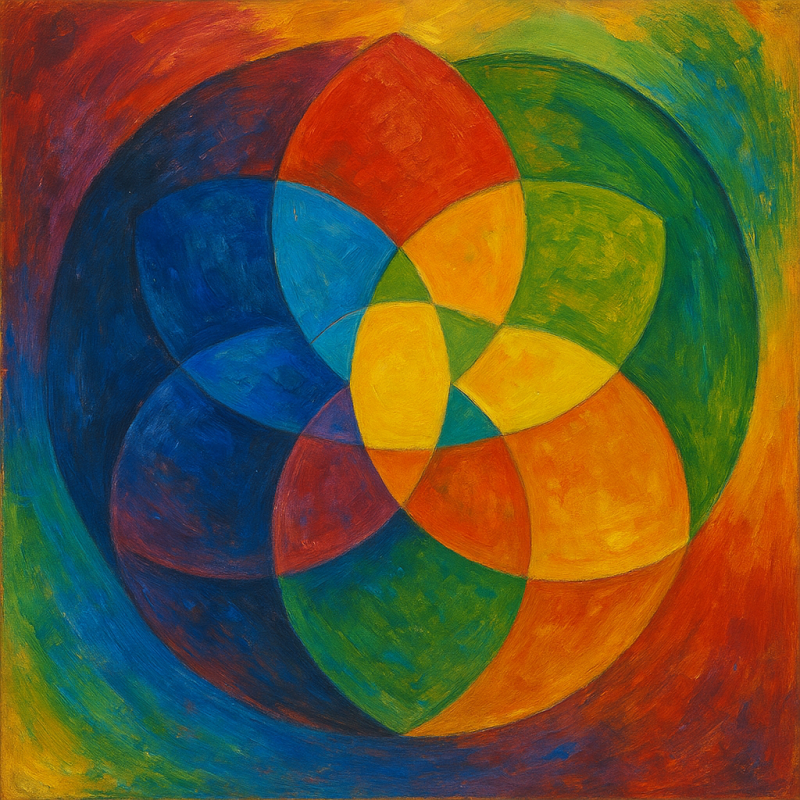
In August 2023, I read Ikigai: The Japanese Secret to a Long and Happy Life by Héctor Garcia. Since then, I have been exploring how the concept of Ikigai can be translated into colour. Over the course of eight months, I experimented on myself, testing how this method could be applied in practice in combination with colour. This journey of exploration led me back to nature and ultimately enabled me to activate the four components of Ikigai using 110 natural colours.
I assigned each component a colour based on the Colour Comfort Method. I then examined each component individually, approaching it from different perspectives. With every shift in perspective, the base colour remained the same, but its shade changed. These variations in shade represented the actions required to bring each perspective into practice.
The four components are:
- what you love
- what others benefit from
- what you are good at
- what you can be paid for
Case study: red for action
I assigned the third component the colour red: the colour of action. If I am good at something and want to develop it further, I need to connect it to concrete actions in order to move forward. Three key questions guided this process:
a. Where do I start?
b. How do I start?
c. What do I need in order to start?
With each question, the colour red shifted:
- Pink-red served as a reminder to stay true to myself and protect my boundaries. Start at the beginning. I returned to old notes from my early days as an entrepreneur: my mission, vision and approach. I relived the excitement and joy I felt when I first started my business.
- With brown-red, I turned inward and began to write. From this process, I distilled a clear selection of products and services that I wanted to develop. Crucially, a message reinforced by pink-red, I made sure not to overextend myself during this creation phase. I can only care for others when I am standing strong myself.
- Brown-purple-red spoke to both my ego and my essence. What is financially feasible for me to create and where am I unwilling to compromise?
Dynamic and practice-oriented
The fact that the colours changed depending on the situation highlights how dynamic and practically applicable this approach is. By analysing subtle nuances and shifts in shade, I ultimately arrived at 110 distinct colours. What stood out to me was that all of these could be traced back to ten natural colours. In this way, my journey came full circle: back to nature.
This experiment gave me deeper insight into both the Ikigai method and the influence of colour on our everyday fluctuations. Colours not only indicate which steps to take, but also guide you back to your core and activate creative forces. This approach proves to be highly effective when making decisions and navigating challenges.
The Ikigai method and the power of colour work hand in hand, guiding us on a journey of discovery towards personal fulfilment.